
What Is a Diamond Certificate? Reading and Verifying a GIA Report
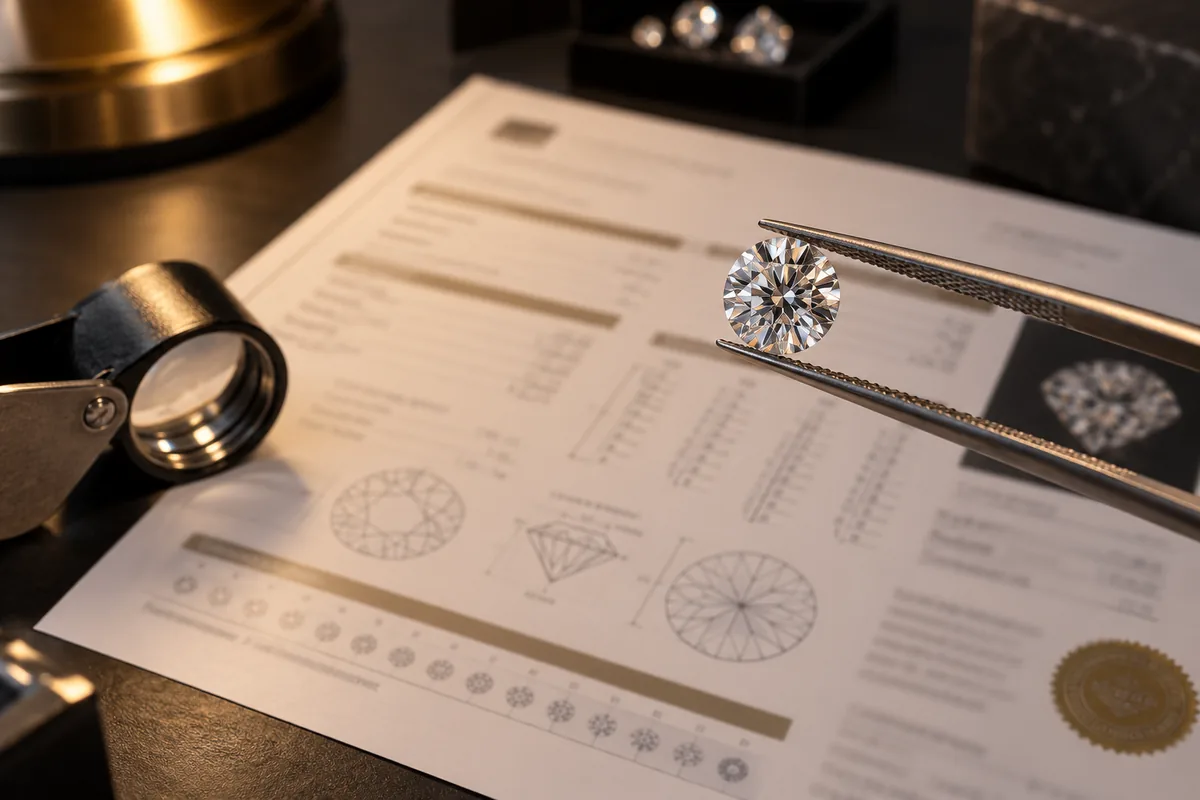
A diamond certificate is an independent lab report on the 4Cs, so you know what you paid for. How to read a GIA report and verify the number online, free.
In this article
What Does a Diamond Certificate Actually Do for You?
A certificate turns the seller's description into something you can check. A diamond certificate is a grading report on that one specific stone, issued by an independent laboratory that does not sell diamonds. It buys you three concrete things: proof you received the specification you paid for, a common scale for comparing prices between shops, and a far easier resale or valuation later.
This matters because grade differences convert straight into money. Two stones of identical size a few grades apart can differ by tens of thousands of baht while looking identical to the naked eye — the report is the only thing that puts buyer and seller on the same numbers.
At ZILVY every natural diamond from 0.30ct carries a GIA report, and lab-grown stones from 0.30ct carry an IGI report. We always suggest verifying the number yourself before paying the balance.
- Confirms the specification — colour, clarity, cut and weight measured by someone with no stake in the sale.
- Makes prices comparable — two diamond prices only mean something when you know both grades exactly.
- Easier to resell — the next buyer does not have to trust you; they just check the report number themselves.
What GIA Is and Why It Matters
GIA (Gemological Institute of America), founded in 1931, created the 4C standard the entire industry uses today. As an independent non-profit that sells no diamonds itself, it has no incentive to inflate grades.
A GIA report is effectively a diamond's birth certificate — verifiable identity and quality, unlike in-house certificates graded by the seller.
| Institute | Trustworthiness | Grading Strictness | Approx. Certificate Cost |
|---|---|---|---|
| GIA | Highest — the global industry benchmark; most trusted by banks and resale buyers | Strictest — conservative grading, often at or slightly below what sellers expect | Highest of the three |
| IGI | Widely recognized globally — the leading lab specifically for lab-grown diamonds | Somewhat looser than GIA — stones often grade a notch higher than an equivalent GIA report | Moderate — lower than GIA |
| HRD | Well recognized in Europe, especially Antwerp, Belgium — less globally widespread than GIA | Fairly strict, close to GIA standards | Moderate to low — similar to IGI |
How to Read a GIA Report
The key values are the 4Cs — Carat weight, Color (D best through Z), Clarity (FL through I3), and Cut (Excellent through Poor) — plus proportions, fluorescence, and a plot of the stone's inclusions.
Every ZILVY diamond is D color, VVS-VS clarity, and 3EX cut (Excellent cut, polish, and symmetry) — the top of each scale.
How to Verify a Certificate
Every GIA report has a number you can verify free at GIA Report Check (gia.edu). Most stones 0.18ct and up also have the number laser-inscribed on the girdle, visible under magnification.
At ZILVY, every diamond 0.30ct and above comes with its GIA report — and we encourage customers to verify the number themselves.
FAQ
What is a diamond certificate actually for?
It is a grading report on one specific stone from an independent laboratory that sells no diamonds. It proves you received the specification you paid for, lets you compare prices between shops on the same scale, and makes resale far easier, since the next buyer can verify the report number themselves for free.
Is a shop's own warranty card the same as a certificate?
No. A certificate comes from an independent lab such as GIA or IGI and is traceable by report number. A shop warranty is written by the seller — useful for workmanship and aftercare, but it is not third-party grading. Ideally you have both, and neither replaces the other.
Can I buy a diamond without a GIA certificate?
Yes, from a trustworthy seller. Small stones (under 0.30ct) usually skip GIA grading because the fee is high relative to the stone's price — but larger stones should always be certified, since one grade difference can mean tens of thousands of baht.
Is GIA different from HRD or IGI?
All are recognized labs, but GIA is considered the strictest and most widely accepted standard worldwide — GIA-certified diamonds resell more easily and hold value better.
Where do I verify a GIA certificate online?
At gia.edu under Report Check — enter the report number and the full grading data appears. Free, no account needed.