
The 4Cs Explained: How to Get the Most Diamond for Your Budget
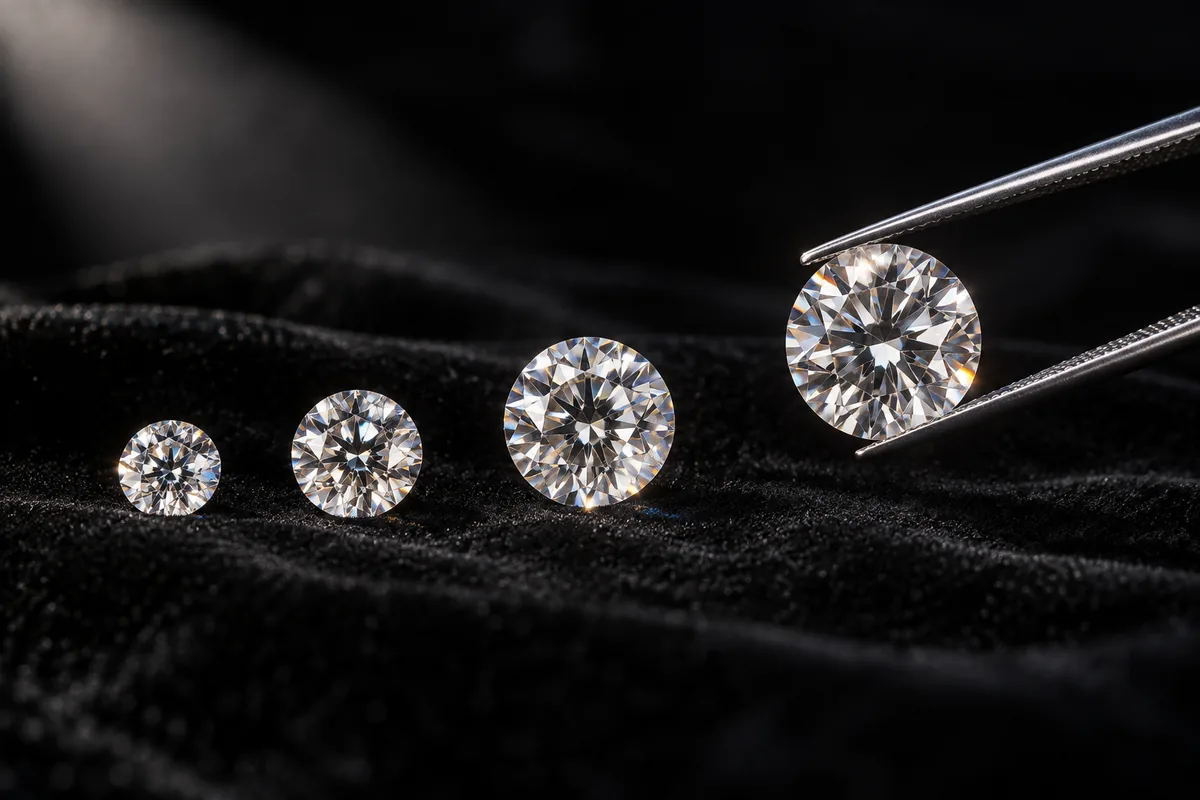
Understand the diamond 4Cs — carat, color, clarity, cut — in plain language, plus which Cs deserve your money and where you can save invisibly.
In this article
The 4Cs in Plain Language
The 4Cs are the four criteria every diamond in the world is graded on: Carat (weight), Color, Clarity and Cut. GIA defined the standard, and every grading report leads with these four values. Once you know what each one measures, you can read a diamond price tag and see exactly why two similar-looking stones differ by tens of thousands of baht.
Carat is weight (not size directly). Color grades whiteness from D down to Z. Clarity measures internal flaws. Cut — the biggest driver of sparkle — grades how well the stone was faceted.
Price climbs along all four axes at once, so smart buying means knowing which Cs are visible to the eye and which exist only on paper. The table below puts all four side by side.
| C | What it measures | Grading scale (GIA) | Price impact | ZILVY's practical advice |
|---|---|---|---|---|
| Cut | Proportions, polish and symmetry — how well the stone returns light | Excellent → Very Good → Good → Fair → Poor | High — and the only axis where a grade drop is obvious to the naked eye | Never compromise. Every stone we set is 3EX (Excellent cut, polish, symmetry) |
| Color | How little body colour the stone has — less colour reads whiter | D (colourless) → Z (light yellow) | High — the second most visible factor, especially in white gold and platinum | We standardize on D colour catalog-wide, so there is nothing to compare |
| Clarity | Size and position of inclusions under 10x magnification | FL, IF → VVS1-2 → VS1-2 → SI1-2 → I1-3 | Moderate to high, though from VS upward the difference is invisible without a loupe | VVS-VS is the value sweet spot — eye-clean without paying FL/IF premiums |
| Carat | Weight — one carat is 0.20 grams (not face-up size directly) | From 0.01ct upward, no ceiling | Highest — and it jumps at every round milestone such as 0.50ct and 1.00ct | Buy just under a milestone, or let a halo design carry the visual size |
Where to Spend: Cut and Color
Never compromise on Cut — the best color means nothing without sparkle, which is why every ZILVY diamond is 3EX Excellent. Color is the second most visible factor, especially on white-gold settings, where a D color stone reads unmistakably icy.
That's why ZILVY standardizes on D color across the board instead of making customers comparison-shop grades.
Where to Save: Clarity and Carat Strategy
VVS-VS clarity is the sweet spot — inclusions visible only under 10x magnification, indistinguishable by eye from far pricier FL/IF stones. For carat, avoid round numbers: a 0.90ct looks nearly identical to a 1.00ct at a much lower price.
Design can also do the work — a halo setting makes the center stone read visibly larger without paying for extra carats.
FAQ
Which of the 4Cs matters most on a limited budget?
Cut. It is the only C where a lower grade is obvious without magnification — a poorly cut stone looks dull no matter how good its color and clarity are. Color comes next, then clarity. Carat is the most flexible: shaving a little weight saves real money while the face-up size barely changes.
How much does a 1 carat diamond cost?
It depends on the 4Cs and on the stone type. At ZILVY a 1.00ct D/VVS/3EX lab-grown stone starts around 19,000 THB, while a natural D color diamond of the same size starts around 179,000 THB. The gap comes from the stone type alone, not from grade or workmanship.
What does "D color" mean?
D is the highest color grade on the GIA scale — completely colorless. In Thai it's called "nam roi" (100% water). Every ZILVY diamond is D color.
How many carats is enough for an engagement ring?
There's no magic number — it depends on budget and finger size. 0.30-0.50ct reads beautifully on an average finger, and halo or side-stone designs make it look larger still.
VS vs VVS clarity — how different are they?
Both have inclusions invisible to the naked eye; they differ only under 10x magnification. Worn on the hand, there is no visible difference.